> ## Documentation Index
> Fetch the complete documentation index at: https://hyperframes.heygen.com/llms.txt
> Use this file to discover all available pages before exploring further.
# Work with source and an agent
> Edit project files, diagnose a failed check, and hand the right context to an AI agent.
Studio, your agent, and the CLI work on the same project files. Use **Code** for
a small source change you understand. Use the agent when the change crosses
files, affects project structure, or starts from an unfamiliar failure.
## Choose the smallest safe surface
| Change | Best starting point |
| ---------------------------------------------------------------- | ------------------------------ |
| Visible text, layout, style, media, timing, or supported motion | Canvas, Inspector, or timeline |
| One known value in one known file | Code |
| Story, several scenes, generated animation, or project structure | Agent |
| A reported lint problem with a clear direct fix | Studio or Code |
| An unfamiliar failure or a fix spanning files | Copy to Agent |
The choice is about the change, not a permanent workflow. You can move between
the surfaces without exporting or converting the project.
## Make a focused source edit
1. Open **Code** in the left sidebar.
2. Select the exact file in the project tree.
3. Find the value responsible for the visible result.
4. Make one focused change.
5. Wait for the preview to refresh, then play the affected moment.
The Code editor saves user edits automatically and records them in Studio
history. If a save fails, Studio says that the latest edit was not persisted;
fix the preview-server or connection problem before continuing.
Creating, renaming, moving, or deleting a file can break references elsewhere in the project.
Search for the old path or ask the agent to update every reference.
Avoid editing the same file in Studio and another tool at the same time. If an
external change lands first, the Code editor rejects the conflicting save and
tells you that the latest edit was not persisted. Reload the current file,
review the external change, then apply your edit again. The separate queue for
visual canvas edits can pause and show a banner while a conflict is resolved.
## Ask about the selected element
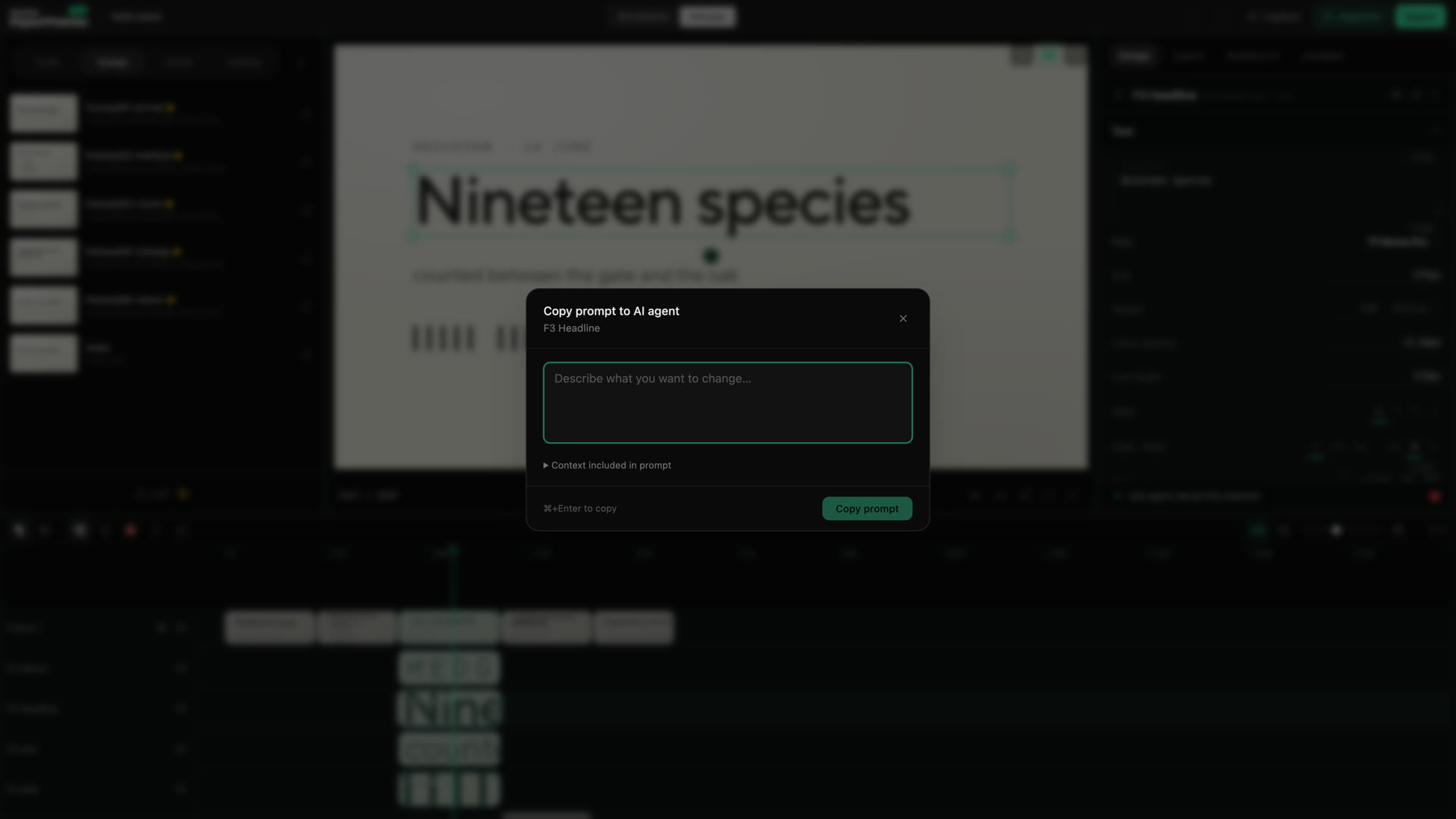
When a visible element needs source work, select it and choose **Ask agent about
this element**. Studio prepares the element and project context, combines it
with your instruction, and copies the prompt to the clipboard. Paste that
prompt into your agent chat.
 ```text theme={null}
Keep the current narration and scene order. Make this product panel readable
at the final video size, and do not change the following scene.
```
The copied context tells the agent where to look. Your sentence tells it what
must remain true.
## Run Studio Lint
Choose **Lint** at the bottom of the left sidebar. Studio opens **HyperFrame
Lint Results** with errors, warnings, file locations, and fix hints when they
are available.
Fix a simple, understood issue directly, then run Lint again. Use **Copy to
Agent** when the source location is unfamiliar or the fix may affect other
files. Add what happened before the error and what you expected:
```text theme={null}
This appeared after I shortened the intro clip. I expected the title animation
to keep its current timing. Fix the issue without changing the rest of the
opening.
```
Do not paste only the error message when the intended result matters. A
technically valid repair can still make the wrong creative change.
## Use the project-level gates before delivery
Studio Lint is a quick in-editor pass. The project-level commands remain the
final gate, especially when the project contains nested compositions:
```bash theme={null}
npx hyperframes lint
npx hyperframes check
```
`lint` checks the composition structure. `check` adds browser, runtime, layout,
motion, and WCAG contrast verification.
Passing checks do not approve the story or the final encode. Play the project
after a source fix, then watch the rendered file before sharing it.
## When the preview and source disagree
1. Stop editing until the latest save finishes.
2. Keep the first exact error or save warning.
3. Reload the project only after checking whether another tool changed the file.
4. Run the project checks.
5. Ask the agent with the error, project path, action that caused it, and result
you expected.
Use [Studio troubleshooting](/studio/troubleshooting) for editor, preview, and
render-queue failures. Use [Finish and share](/guides/export-and-share) for the
complete approval, validation, render, and delivery path.
## Related topics
* [Recover from a Studio problem](/studio/troubleshooting)
* [Understand a HyperFrames project](/concepts)
* [Finish, render, and share](/guides/export-and-share)
## Related topics
- [Create a custom video](/guides/general-video.md)
- [Work on a project in Studio](/studio/index.md)
- [How a HyperFrames project works](/concepts/index.md)
```text theme={null}
Keep the current narration and scene order. Make this product panel readable
at the final video size, and do not change the following scene.
```
The copied context tells the agent where to look. Your sentence tells it what
must remain true.
## Run Studio Lint
Choose **Lint** at the bottom of the left sidebar. Studio opens **HyperFrame
Lint Results** with errors, warnings, file locations, and fix hints when they
are available.
Fix a simple, understood issue directly, then run Lint again. Use **Copy to
Agent** when the source location is unfamiliar or the fix may affect other
files. Add what happened before the error and what you expected:
```text theme={null}
This appeared after I shortened the intro clip. I expected the title animation
to keep its current timing. Fix the issue without changing the rest of the
opening.
```
Do not paste only the error message when the intended result matters. A
technically valid repair can still make the wrong creative change.
## Use the project-level gates before delivery
Studio Lint is a quick in-editor pass. The project-level commands remain the
final gate, especially when the project contains nested compositions:
```bash theme={null}
npx hyperframes lint
npx hyperframes check
```
`lint` checks the composition structure. `check` adds browser, runtime, layout,
motion, and WCAG contrast verification.
Passing checks do not approve the story or the final encode. Play the project
after a source fix, then watch the rendered file before sharing it.
## When the preview and source disagree
1. Stop editing until the latest save finishes.
2. Keep the first exact error or save warning.
3. Reload the project only after checking whether another tool changed the file.
4. Run the project checks.
5. Ask the agent with the error, project path, action that caused it, and result
you expected.
Use [Studio troubleshooting](/studio/troubleshooting) for editor, preview, and
render-queue failures. Use [Finish and share](/guides/export-and-share) for the
complete approval, validation, render, and delivery path.
## Related topics
* [Recover from a Studio problem](/studio/troubleshooting)
* [Understand a HyperFrames project](/concepts)
* [Finish, render, and share](/guides/export-and-share)
## Related topics
- [Create a custom video](/guides/general-video.md)
- [Work on a project in Studio](/studio/index.md)
- [How a HyperFrames project works](/concepts/index.md)